
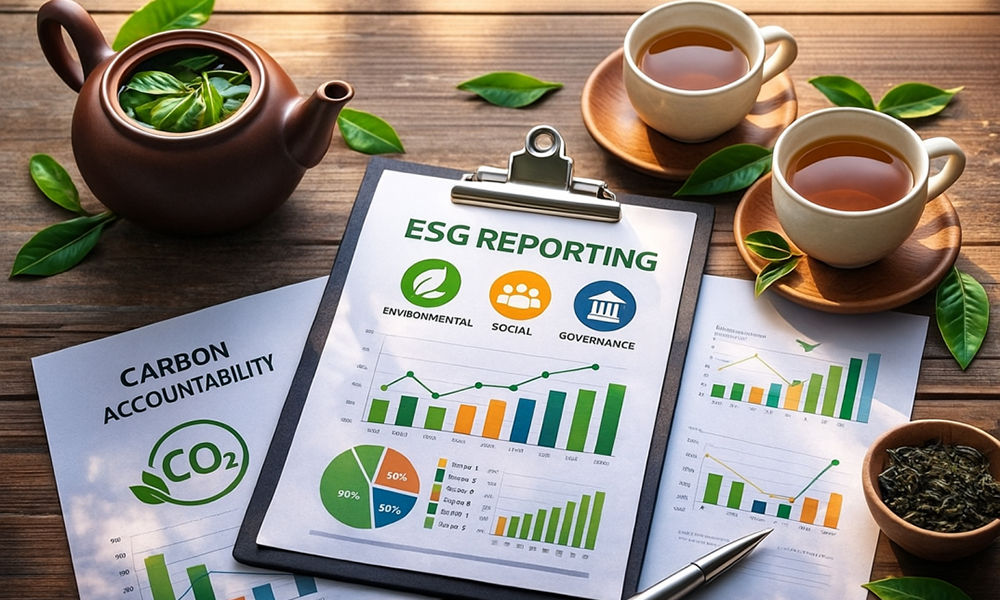
Carbon Accountability and ESG Reporting
“Transparency Equals Trust!”
In the modern global marketplace, trust is currency. For tea producers supplying international buyers in Europe, Japan, and North America, this trust is now earned not only through the flavor and consistency of the product but also through the carbon transparency and social responsibility behind it.
The world’s leading importers and retailers are demanding clear evidence that every kilogram of tea they purchase comes from operations aligned with Environmental, Social, and Governance (ESG) principles. This shift has transformed sustainability from a moral choice into a business imperative. In 2025, transparency equals trust, and those who measure and report their environmental performance are the ones securing long-term market access.
The ESG Mandate for the Tea Industry
Over the past decade, buyers across Europe and Japan have introduced stringent sustainability standards that require tea factories to calculate and report their Scope 1 and Scope 2 emissions, covering direct emissions from fuel use and indirect emissions from purchased electricity. Alongside carbon, there is growing scrutiny over water use, waste generation, and labor conditions.
For many tea producers in Sri Lanka and Africa, these expectations have presented both a challenge and an opportunity. The challenge lies in collecting accurate operational data from traditionally manual systems; the opportunity lies in leveraging that data to prove environmental leadership and secure premium buyers.
From Engineering to Accountability
Recognizing this evolving need, Walkers Sons & Company has expanded its role from a machinery manufacturer to a sustainability partner. The company’s engineering teams are now actively helping tea factories across regions align with international ESG frameworks.
Through intelligent machinery upgrades, Walkers enables factory owners to measure, monitor, and report their energy footprints in real-time. Each piece of modernized equipment, from rollers to dryers, can be fitted with energy sensors and smart controllers that record consumption data for both internal analysis and third-party reporting.
Beyond hardware, Walkers provides consultative guidance on clean energy transitions, helping clients replace high-emission systems with energy-efficient alternatives such as variable frequency drives (VFDs), biomass-fed dryers, and solar-assisted systems. This dual focus on technology and transparency allows tea producers to demonstrate tangible progress toward carbon reduction targets.
Building Data-Ready Factories
ESG reporting begins with data. Yet, for many tea factories, this data has historically been scattered or undocumented. Walkers’ latest factory modernization projects integrate digital dashboards that compile operational metrics—fuel use, electricity draw, output efficiency, and waste generation—into a single, easy-to-audit platform.
This not only simplifies reporting to international buyers but also gives factory managers valuable insights into performance optimization. Data-driven visibility helps identify inefficiencies, manage maintenance schedules, and support continuous improvement cycles—essential foundations of any modern sustainability strategy.
Social Responsibility in the Mechanized Era
While carbon and energy metrics dominate headlines, the “S” in ESG—social responsibility—remains just as critical. Walkers’ approach to modernization recognizes that sustainable technology must also uplift the people behind the machines.
Through factory training programs, Walkers helps teams transition smoothly into digitally enabled operations, empowering workers to adapt to new technology without displacement. The goal is to build confidence, not dependency, ensuring that progress in automation enhances livelihoods rather than replaces them.
Global Buyers, Local Action
European and Japanese buyers are increasingly tying procurement contracts to verifiable ESG compliance. This means that factories equipped to demonstrate low-carbon and socially responsible production stand to gain preferential access, stronger pricing, and reputational advantage.
Walkers’ partnerships with factories across Sri Lanka, Kenya, and Rwanda have already shown how engineering innovation can drive ESG excellence. By combining mechanical expertise with sustainability intelligence, these producers are not just meeting global standards—they are helping redefine them.
The Future: Transparent, Traceable, Trusted
The tea industry’s future will be defined by data-backed transparency. In this new landscape, every factory’s environmental performance will be as important as its product quality. Walkers is ensuring that its clients are prepared for that reality, not through rhetoric, but through results.
By embedding measurement tools into its machines and supporting clients with practical reporting solutions, Walkers is helping the tea industry take a confident step into a transparent, traceable, and trusted era.
As markets evolve, one truth becomes clear: transparency is not a trend, it’s the foundation of trust. And trust, in the world of tea, is everything.